
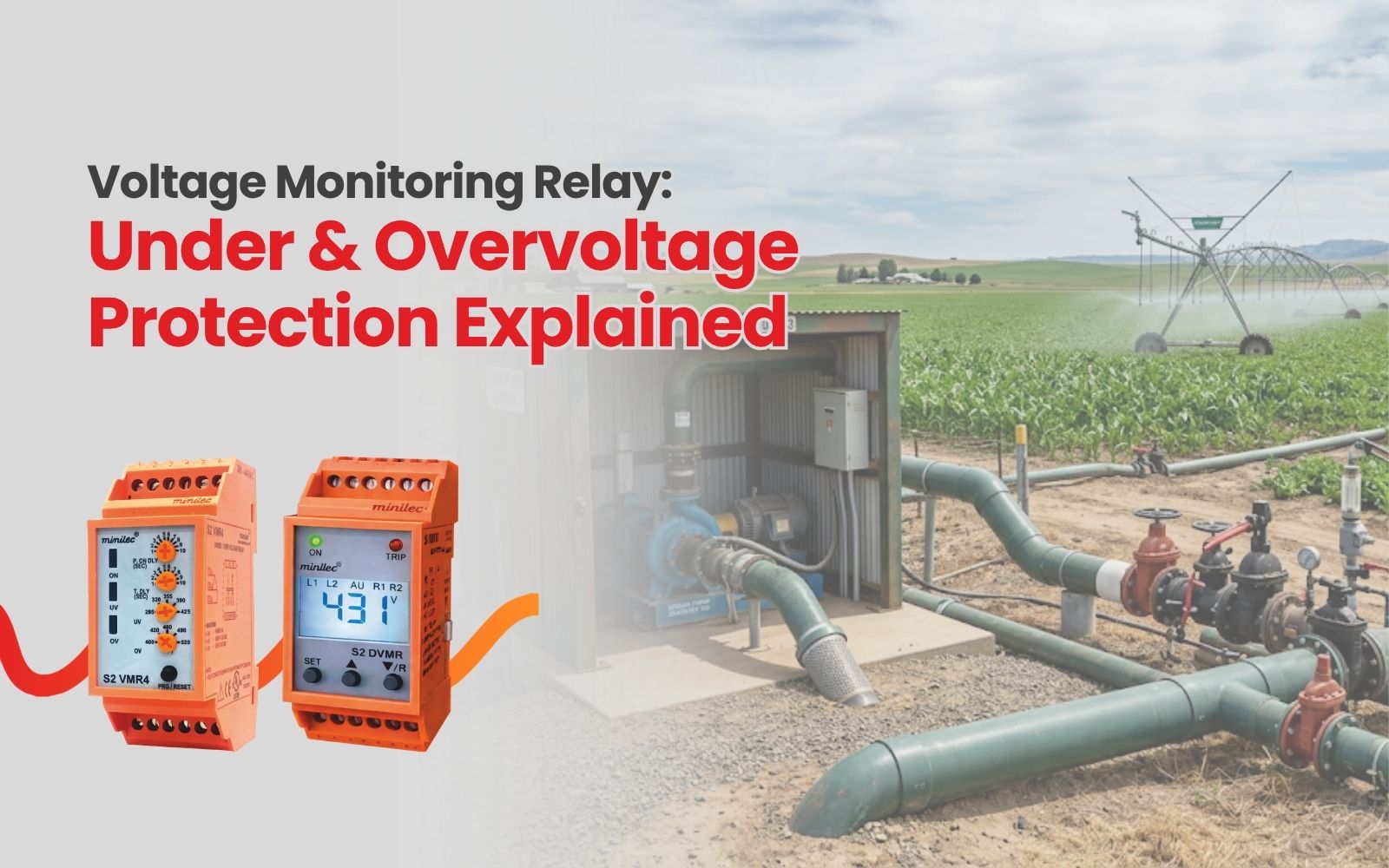
A pump station in a farm irrigation setup was tripping every few days. There was no burnt wiring and no visible fault. The motor restarted after some time, but the issue kept returning. The real cause was supply voltage dipping below the motor’s rated level during peak load hours. The motor protection was reacting to the symptom. The panel needed a voltage monitoring relay watching the supply.
A voltage monitoring relay continuously measures incoming voltage and disconnects the load when voltage moves outside a safe, pre-set range. The same device may also be called an under-voltage relay, over-voltage relay or voltage protection relay. These are usually not different products. They describe the same protection function from different angles.
An under voltage relay trips when supply voltage drops below the set limit. An over voltage relay trips when voltage rises above the set limit. A voltage protection relay normally covers both conditions in one unit, helping protect motors, compressors, transformers and control circuits.
How it works
Inside the relay, a measuring circuit compares incoming voltage with set thresholds. In three-phase systems, it may also monitor phase loss, phase sequence and voltage imbalance.
Two settings matter during selection. The first is trip delay. A short dip caused by a large motor starting nearby should not stop the entire panel. Adjustable trip delay helps avoid nuisance tripping during minor disturbances, while still acting when the voltage problem continues.
The second is adjustable setpoints. Different applications need different voltage limits. Sensitive control electronics may need tighter settings than a standard induction motor. Adjustable under voltage and over voltage settings make the relay usable across different panels.
Why both under and over voltage matter
Under voltage can reduce motor torque. To compensate, the motor may draw more current and move closer to thermal stress. It can also cause contactors and control relays to drop out.
Over voltage can stress insulation, damage electronics and accelerate winding degradation in motors and transformers. In severe cases, damage can happen quickly.
This is why one-sided protection is not enough. A practical voltage monitoring relay should monitor both under and over voltage conditions.
Where it is used
Voltage monitoring relays are commonly used in transformer panels, battery charger panels, AC/DC converter panels, chiller and AHU compressor circuits, water pumping stations, farm irrigation panels, crane panels and hoist motor panels.
Choosing the right relay
Before selecting a relay, check the supply type, 3-wire or 4-wire system, trip delay range, need for phase loss or phase sequence protection, and whether an inbuilt display will help site technicians.
Minilec voltage monitoring relay range
S2 VMR series supports single and three-phase voltage monitoring with adjustable under and over voltage settings and configurable trip delay.
F3 VSR5 adds RS485 Modbus RTU communication.
S2 DVMR offers display-based visibility and setting adjustment.
If your panel protects equipment that cannot afford unnoticed voltage dips or spikes, selecting the right voltage monitoring relay becomes an important protection decision.