
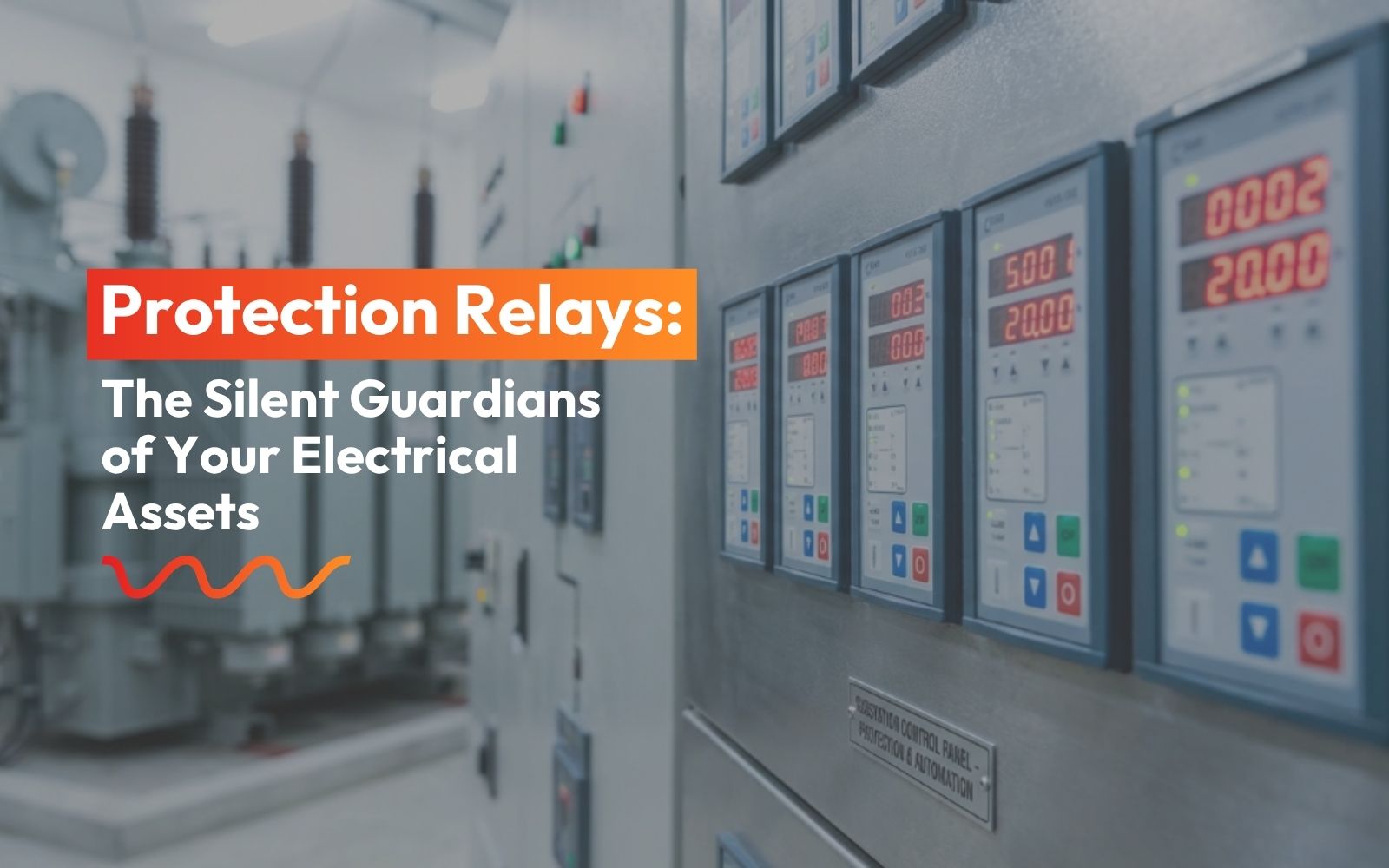
Every electrical power system, whether a small industrial plant or a large utility grid – faces the constant threat of faults: short circuits, overloads, voltage sags, and equipment failures. When a fault occurs, milliseconds matter.
Protection relays are the intelligent devices that detect these abnormal conditions and initiate corrective action. They don’t just protect equipment; they ensure safety, prevent downtime, and save lives.
In this guide, we’ll explore what protection relays are, how they’re classified, the types available, and how they work with instrument transformers to create secure zones of protection.
What Is a Protection Relay?
According to the Institute of Electrical and Electronic Engineers (IEEE C37.100-1992) , a protective relay is:
“A relay whose function is to detect defective lines or apparatus or other power system conditions of an abnormal or dangerous nature and to initiate appropriate control circuit action.”
Importantly, a protection relay may consist of multiple relay units, each responsive to a specific input (electrical, mechanical, thermal, or a combination). Limit switches and similar devices are not considered protective relays.
Functional Categories of Relays
Relays in industrial and utility applications fall into five functional categories. Protection relays are just one part of this ecosystem:
Category | Function |
Protective relays | Detect defective equipment or dangerous conditions and initiate switching or alarms. |
Monitoring relays | Verify conditions on the power system or within the protection system itself. |
Programming relays | Establish or detect electrical sequences (e.g., in logic control). |
Regulating relays | Act when an operating parameter deviates from predetermined limits. |
Auxiliary relays | Operate in response to the opening/closing of other circuits – includes timers, lock‑out relays, trip relays. |
How Are Protection Relays Classified?
Protection relays can be grouped by input, operating principle, and performance characteristics.
By Input
- Current
- Voltage
- Power
- Frequency
- Temperature
- Pressure
- Flow
- Vibration
By Operating Principle / Structure
- Electro‑mechanical: Uses electromagnetic forces and moving parts.
- Solid state: Uses electronic circuits without moving contacts.
- Digital (numeric): Uses a microprocessor for analysis and communication.
- Thermal: Responds to heat generated by current.
By Performance Characteristics
- Inverse‑time or definite‑time overcurrent
- Directional overcurrent
- Distance (impedance)
- Undervoltage / overvoltage
- Ground fault or phase fault
- High‑speed or slow‑speed operation
- Phase comparison / directional comparison
Types of Protection Relays: Digital vs. Electro‑Mechanical
Electronic Relays
The earliest form of protection relay, still widely used today. They operate using electromagnetic coils, springs, and moving contacts.
Characteristics:
- Manage one or two protective functions per relay
- Highly robust and well‑understood
- Slower operating times compared to digital relays
- No communications or data logging capability
Typical applications: Simple overcurrent protection, backup protection in existing panels.
Digital (Numeric) Protection Relays
A digital protection relay uses a microprocessor to analyze voltages, currents, and other quantities. It can perform multiple protective functions in a single unit.
Characteristics:
- High speed and precision
- Programmable logic (PLC‑like capabilities)
- Communications (Modbus, IEC 61850, etc.)
- Event recording and fault location
- Self‑monitoring and diagnostics
Typical applications: Modern switchgear, motor protection, transformer protection, feeder protection.
Zones of Protection
A fundamental concept in protection engineering is dividing the power system into zones of protection. Each zone is protected by its own set of relays and zones often overlap to eliminate blind spots.
Common zones include:
- Generators
- Transformers
- Buses and distribution feeders
- Transmission lines
- Motors
Overlapping zones for example, a transformer zone overlapping with the generator zone ensures that a fault inside the transformer is cleared by both primary and backup protection. This redundancy is achieved by strategic placement of CTs and VTs, or by using duplicate relay schemes.
Design Criteria for Protection Relay Systems
Protection relays are designed and applied with five key objectives in mind:
- Reliability: The relay must operate when it should (dependability) and not operate when it shouldn’t (security).
- Speed: Faster fault clearing minimizes equipment damage and maintains system stability. Typical operating times range from one cycle (16.7 ms at 60 Hz) to a few seconds for backup functions.
- Selectivity: Only the faulted section should be isolated, leaving the rest of the system in service.
- Economics: The protection scheme must provide maximum protection at a reasonable cost – balancing sophistication with budget.
- Simplicity: Minimal equipment, clear circuitry, and straightforward operation reduce the chance of misoperation and simplify maintenance.
Applications of Protection Relays
Wherever electricity is used, protection relays are likely present. Key applications include:
- Power generation: Generator protection against stator faults, loss of excitation, overspeed.
- Transmission & distribution: Line distance protection, feeder overcurrent, busbar protection.
- Industrial plants: Motor protection, transformer protection, capacitor bank protection.
- Commercial buildings: Incoming feeder protection, emergency generator controls.
- Renewable energy: Solar inverter protection, grid interface protection.
Beyond heavy industry, simpler relays (though not always classified as “protective”) are found in HVAC systems, elevators, traffic controls, and robotics.
Why Choose Minilec for Protection Relays?
Minilec has been a trusted name in industrial automation and protection for decades. Our portfolio includes:
- Digital protection relays with advanced communication and programmability
- Thermal overload relays for motor protection
- Voltage and frequency monitoring relays
- Customised protection panels for critical applications
We understand that every application is unique. Whether you’re upgrading an old panel with electro‑mechanical relays or designing a new substation with digital protection, Minilec provides the expertise and products to keep your system safe and reliable.
Protection relays are the unsung heroes of electrical infrastructure. They work silently in the background, ready to act in milliseconds when a fault occurs. Understanding their types, classifications, and design principles is essential for anyone responsible for power system reliability.
Need help selecting the right protection relay for your application?
Contact Minilec today, our engineers are ready to guide you from concept to commissioning.
Conclusion
Understanding the 5 kinds of industrial relays is not just academic – it directly impacts the reliability, safety, and efficiency of your electrical systems. Whether you’re building a new control panel or troubleshooting an existing one, choosing the correct relay type saves time, money, and downtime.
Need help selecting the right relay for your project?
Contact Minilec today – our engineers are ready to assist.