
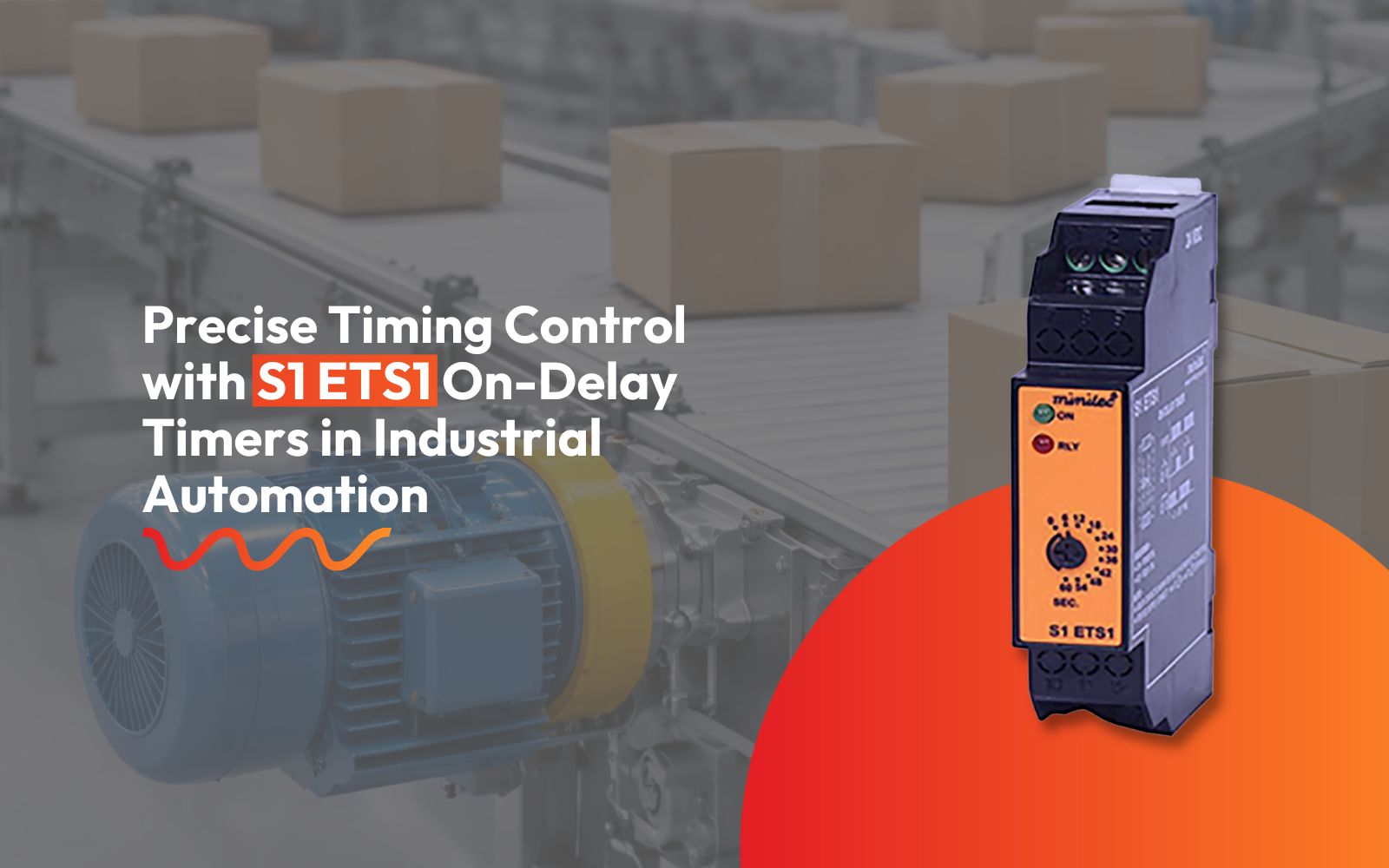
In the industrial automation, timing isn’t just a convenience it’s the heart beat of efficient and safe operations. Imagine a conveyor system where motors must start in a precise sequence to prevent jams or a ventilation fan / Blowers that needs a delayed start after a furnace ignites. This is where the on-delay timer becomes an indispensable component. The Minilec S1 ETS1 On-Delay Timer exemplifies this crucial technology, offering engineers a reliable and compact solution for controlled delays into electrical circuits.
How an On-Delay Timer Works: The S1 ETS1 in Action
Understanding the core function of an on-delay timer is key to leveraging its power. The basic working principle is elegantly simple yet profoundly useful in complex systems.
The Step-by-Step Sequence:
- Input Signal Applied: When power (the trigger signal) is applied to the timer’s coil or input terminals, the internal timing mechanism is instantly activated. This is the “start” command.
- Timing Period Elapses: The timer begins counting down its preset delay time. This period can range from fractions of a second to several hours, depending on the model and settings. During this countdown, the output state remains unchanged.
- Output Activation: Only after the preset delay time has fully elapsed do the timer’s internal electromechanical relays or solid-state outputs change state. For example, a normally open (NO) contact will close, energizing the connected load such as a motor starter coil, solenoid valve, or indicator lamp.
- Instantaneous Reset: When the input trigger signal is removed, the timer resets immediately. The output de-energizes without delay, and the timer is ready for the next cycle.
Visualizing the Timing Diagram:
The defining characteristic of an on-delay function is the delayed output relative to the input. In a timing diagram, you see the input signal go high, followed by the output signal going high only after the specified time gap. This contrasts sharply with an off-delay timer, where the output stays on for a set period after the input signal drops.Key Features & Technical Specifications of the Minilec S1 ETS1
The Minilec S1 ETS1 is engineered for robust performance in demanding industrial environments. Here’s a breakdown of its standout features:
- Core Function: Pure on-delay timer (delay on make) operation.
- Compact Design: Its slim, DIN rail mountable housing saves crucial space in crowded control panels, making it ideal for modern, high-density installations.
- Versatile Time Ranges: Typically offers adjustable delay ranges (e.g., 0.1 seconds to 10 hours, model dependent), set via a precise potentiometer or digital dial, providing flexibility for countless applications.
- Durable Output Contacts: Features robust SPDT (Single Pole Double Throw) relay outputs. This provides one normally open (NO) and one normally closed (NC) contact, allowing for flexible circuit design to control various loads.
- Wide Operating Voltage: Designed to work across standard industrial control voltages (e.g., 24V AC/DC, 110V AC, 240V AC), ensuring compatibility with most control panel power supplies.
- Clear Status Indication: Equipped with LED indicators for power and output status, enabling quick troubleshooting and visual confirmation of operation at a glance.
- High Reliability: Built with industrial-grade components to ensure stable timing accuracy and a long mechanical life, even in environments with electrical noise and vibration.
Applications: Where to Use the S1 ETS1
The application of on-delay timers is limited only by an engineer’s imagination. Here are common and critical uses in industrial settings:
- Motor Sequencing & Star-Delta Starters: Preventing simultaneous inrush current by delaying the start of secondary motors in a system or controlling the transition from star to delta in a motor starter circuit.
- Conveyor System Control: Introducing a delay between the start of consecutive belt conveyors to ensure material is properly transferred and to avoid pile-ups and system overload.
- Safety & Interlock Systems: Delaying the activation of a machine or process until a safety guard is confirmed locked or ventilation has run for a minimum time, enhancing operator safety.
- Pump Control: Preventing rapid cycling of pumps in fluid systems, such as delaying a backup pump’s start to allow the main pump to overcome a temporary blockage.
- Lighting & HVAC Control: In building automation, delaying the turn-off of lights in a warehouse after a motion sensor is triggered, or staggering the startup of large compressors in an HVAC system to manage power demand.
- Process Automation: Ensuring a mixing step runs for a precise time after a valve opens, or allowing a chemical reaction vessel to stabilize before initiating heating.
On-Delay vs. Off-Delay: Choosing the Right Timer Function
A common point of confusion is the difference between on-delay and off-delay timers. Selecting the correct function is vital for the intended control logic.
| Feature | On-Delay Timer (Like S1 ETS1) | Off-Delay Timer |
| Core Function | Delays the START of an output | Delays the STOP of an output |
| Sequence | Input ON → Delay → Output ON | Input ON → Output ON Instantly. Input OFF → Delay → Output OFF |
| Reset Behavior | Resets immediately when input is removed | Timing cycle completes even if input returns |
| Typical Use Case | “Wait 5 seconds, then start the motor.” | “When the stop button is pressed, keep the cooling fan running for 2 minutes.” |
| Application Example | Staggered motor startup on a conveyor line | Post-lubrication or cooling cycle for a machine tool after it stops |
Enhance Your System Reliability with Precise Timing Control
The Minilec S1 ETS1 On-Delay Timer is more than just a component; it’s a fundamental tool for introducing intelligence, safety, and order into electrical control systems. Its robust construction, clear functionality, and proven reliability make it a trusted choice for automation engineers worldwide.
Whether you’re designing a new control panel from scratch or troubleshooting an existing sequence, understanding and correctly applying the on-delay principle is essential. By mastering the use of timers like the S1 ETS1, you can create systems that are not only more efficient and easier to maintain but also safer and more dependable.
Ready to integrate precise timing into your next project? Explore the detailed specifications and technical data for the S1 ETS1 series to ensure it meets your application’s voltage, load, and timing range requirements. Visit the official product page or consult with your industrial automation supplier for more information.