
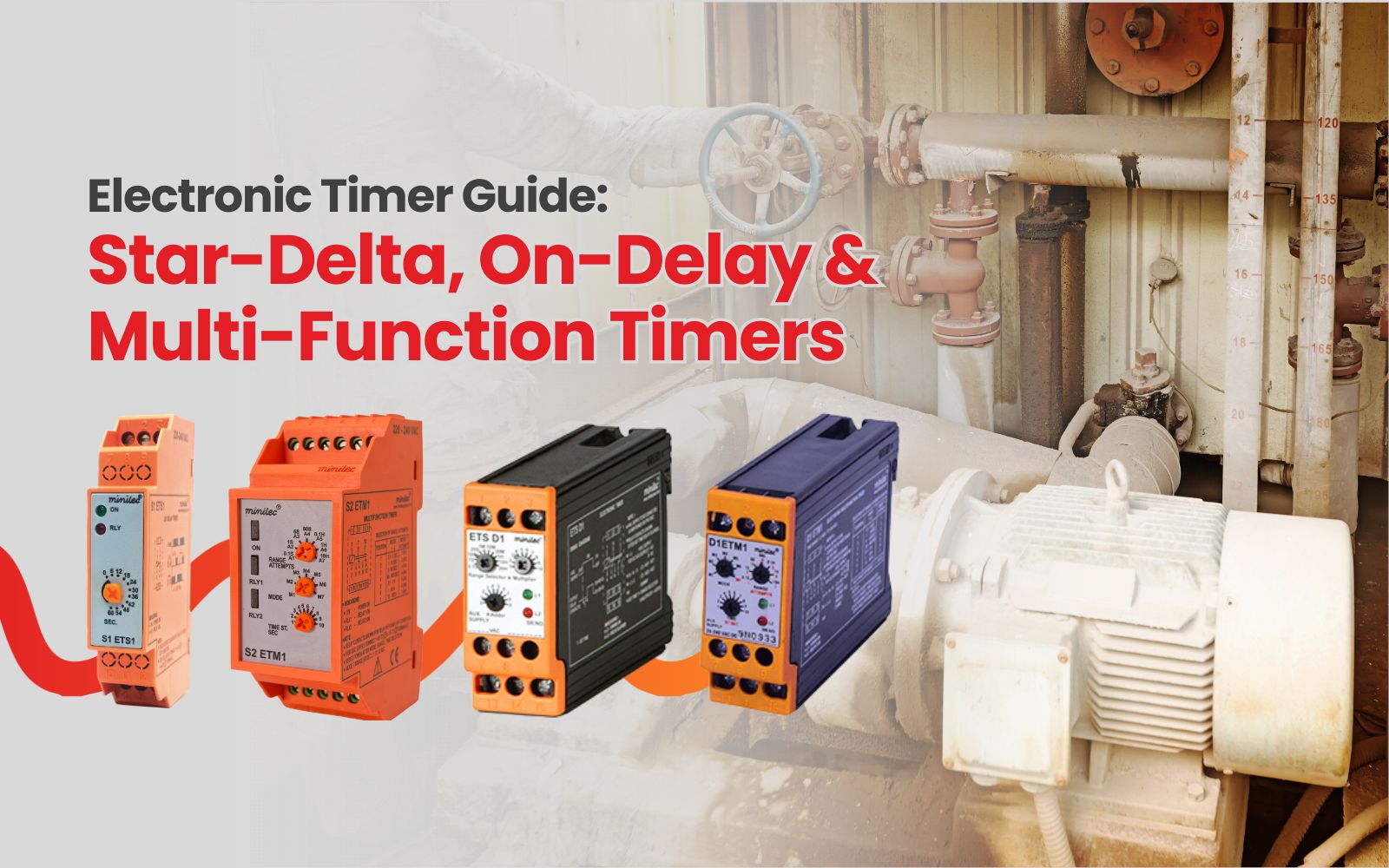
A large fan motor kept tripping during startup. The maintenance team checked the overload relay, contactors and motor winding. Everything looked normal.
Then they checked the star-delta timer.
The changeover from star to delta was happening too early. The motor had not built enough speed, so the current suddenly spiked and the overload relay tripped. Once the timing was corrected, the tripping stopped.
This is why an electronic timer may look like a small component, but it can decide how smoothly a panel operates.
What is an electronic timer?
An electronic timer is a control device that delays, sequences or cycles a switching action based on a set time. Instead of switching instantly, it gives the panel a controlled delay.
This delay is useful in motor starting, restart protection, conveyor sequencing, pump cycling, HVAC compressor protection and many other panel applications.
Compared to older mechanical timers, electronic timers offer better accuracy, repeatability and more stable timing performance.
Common timer types used in panels
An on-delay timer switches its output after a set delay once power or input signal is received. It is commonly used when equipment should not start immediately after power is applied.
A star-delta timer controls motor starting sequence. It keeps the motor in star mode for a set time and then shifts it to delta mode. If this timing is wrong, the motor may trip, start poorly or face unnecessary electrical stress.
A multi-function timer combines different timing modes such as on-delay, interval, cyclic ON/OFF and star-delta functions in one unit. Products like D1 ETM1 are useful where panels need flexible timing options in a compact format.
Why correct timer selection matters
Many site faults appear to be motor faults, overload faults or contactor issues. But sometimes, the real problem is incorrect timing.
For example, high-inertia loads such as fans, blowers and large pumps need enough time during star-delta starting. A fixed or wrongly selected timer may not suit the actual load.
Before selecting an electronic timer, check:
Timing function needed
Time range required
Supply voltage
Mounting type
Panel space
Application requirement
Where electronic timers are used
Electronic timers are widely used in motor control panels, star-delta starters, conveyor systems, HVAC panels, compressor panels, pump panels, automation panels and transformer control panels.
They also work along with other protection and monitoring products used inside industrial panels.
Minilec electronic timer range
Minilec offers Electronic Timers for on-delay, interval delay, cyclic ON/OFF, star-delta changeover and multi-function timing applications.
If your panel needs reliable timing control, choosing the right electronic timer can prevent unnecessary tripping, improve sequencing and support smoother site operation.
Good timing keeps the panel in control.