
Why this matters
Most motor failures aren’t dramatic they’re slow burns. Insulation cooks, resistance creeps up, and one day production halts. S2 WTR1 is built to catch that hidden heat early and trip in <1 second so you fix the cause, not a burnt motor.
What is S2 WTR1?
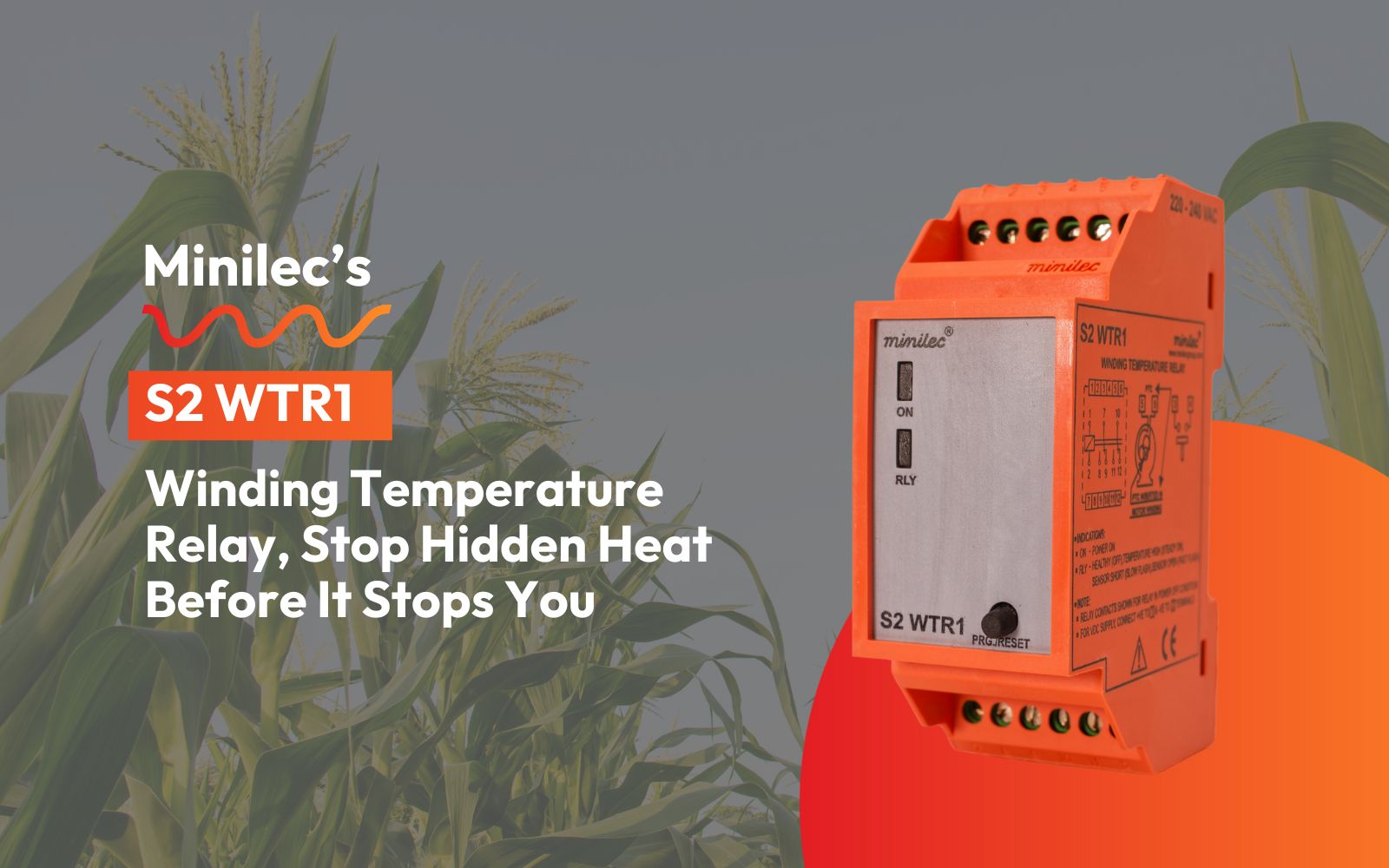
S2 WTR1 is a winding temperature relay that reads PTC thermistors embedded in motor windings. When temperature crosses the thermistor’s rated threshold, resistance shoots up; the relay senses it and trips before damage spreads.
What it senses
- Over-temperature (winding exceeds safe limit)
- Sensor open (broken/loose PTC circuit)
- Sensor short (wiring fault/shorted PTC)
Operator-friendly controls
- Auto / Manual reset (choose what suits your SOP)
- 2 change-over (CO) outputs (flexible interlocks/alarms)
- 35 mm DIN mounting (fast, panel-friendly)
How does S2 WTR1 protect better than just an overload relay?
- Thermal reality vs. electrical proxy: Overload relays infer heat from current; S2 WTR1 measures winding temperature directly with PTCs catching problems even at “normal” current (blocked airflow, high ambient, dust).
- Speed: When windings jump past the threshold, S2 WTR1 trips in <1 s, far faster than many thermal methods.
- Certainty: Open/short sensor detection avoids “silent” protection failures.
Where should I use it?
Anywhere motor temperature risk is high or uptime is critical:
- HVAC/AHU fans, blowers, compressors
- Pumps and submersibles (high ambient, poor cooling)
- Conveyors, crushers, mixers (stall risk)
VFD-driven motors (non-sinusoidal currents; temperature is the truth)
Tip: Pair S2 WTR1 with a motor protection relay (MPR) for current-based faults and first-up clarity in annunciation.
Installation & setup essentials (at a glance)
- PTC sensor selection: Use PTCs with the temperature class recommended by your motor OEM (e.g., 120°C, 140°C).
- Wiring: Run PTC leads separately from power cables; avoid induced noise.
- Testing: Warm-air gun or simulated PTC resistor can validate detection and outputs before commissioning.
- Reset policy: Use Auto for unattended restarts after cool-down; Manual where a visual check is mandatory.
- Interlocks: Map one CO contact to trip circuit; use the second for panel alarm/SCADA.
(Always follow the product datasheet for exact terminals, ranges, and safety instructions.)
Quick comparisons customers ask about
“Do I still need an overload relay?”
Yes. Overload relays protect against over-current; S2 WTR1 protects against actual winding over-temperature and sensor faults. They complement each other.
“How fast is the trip?”
Under one second once the PTC threshold is crossed designed to prevent spread of thermal damage.
“What if the PTC wiring breaks?”
S2 WTR1 detects sensor open and sensor short and trips/indicates accordingly so you’re not running “blind.”
“How many outputs?”
Two CO outputs for clean integration trip and alarm/SCADA, or trip and fan interlock, etc.
“Mounting?”
35 mm DIN rail, panel-friendly. Keep it accessible for quick reset and diagnostics.
Benefits you’ll actually feel on the floor
- Fewer thermal trips (because you catch causes early)
- Predictable uptime (no surprise rewinds)
- Faster troubleshooting (clear indications: over-temp, open, short)
- Cleaner integration (2 CO outputs, DIN rail, simple SOPs)
FAQ (customer questions answered)
Q1. Can S2 WTR1 work with any motor brand?
If the motor has (or can accept) PTC thermistors of the supported class, S2 WTR1 can monitor it. Check the motor OEM recommendations.
Q2. What if my environment is hot, but current looks normal?
That’s the point of winding temperature monitoring S2 WTR1 trips on real heat, not just amps.
Q3. Can I use S2 WTR1 with VFDs?
Yes. VFD harmonics can confuse current-based protection; winding temperature remains definitive.
Q4. How should I choose Auto vs. Manual reset?
Auto: remote sites, unattended cooling periods, safe restart logic.
Manual: on-site verification needed before restart (safety or process-critical equipment).
Q5. How do I send alarms to SCADA?
Use one CO output to your PLC/DI; map it to alarm tags. If you need detailed event context, pair with an annunciator or monitoring relay.
CTA
Want a quick review of your motor protection scheme or wiring map? Ping “Insight” in messages with your application details, or visit minilecgroup.com to talk to our technical team.