
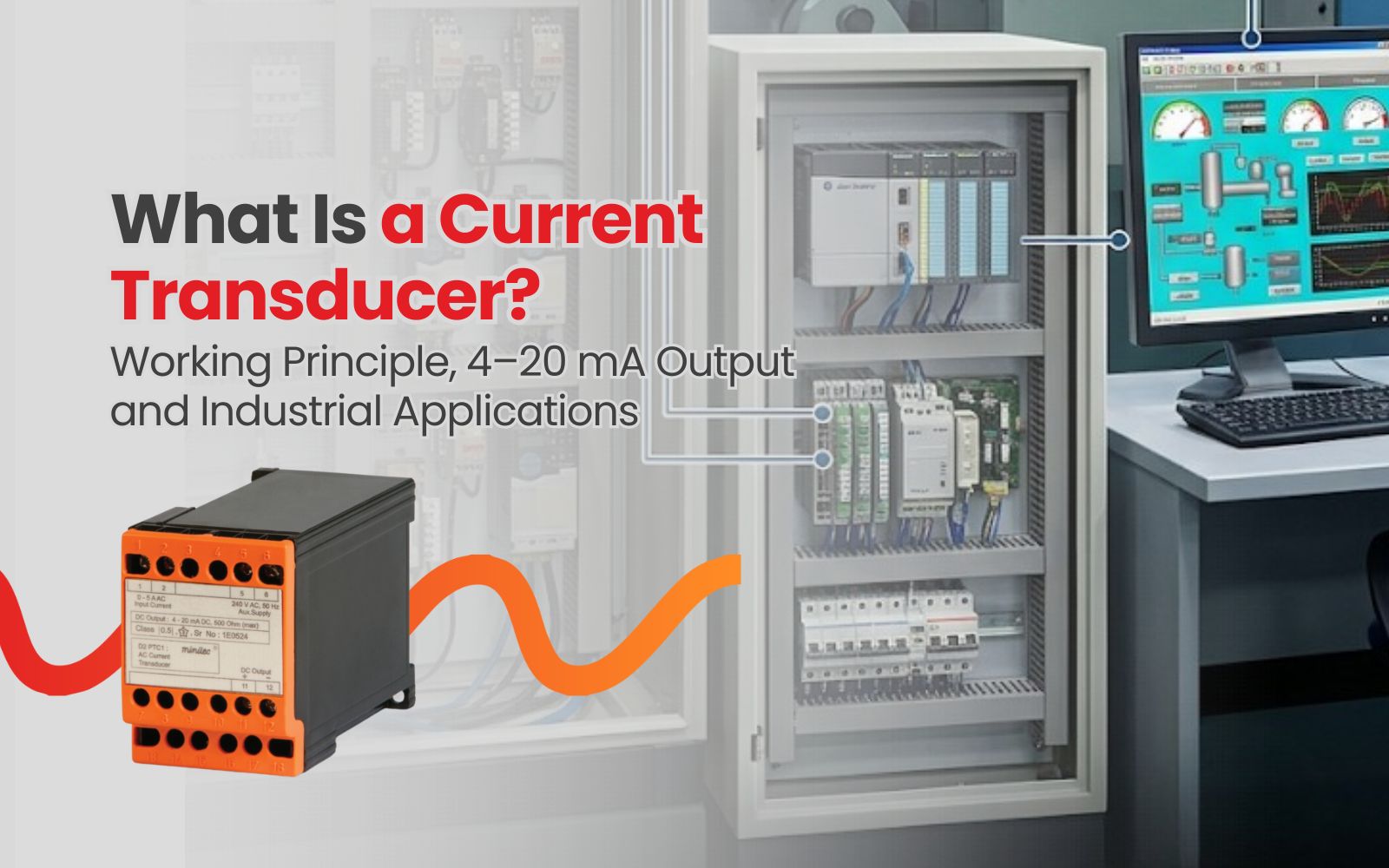
An electrical panel may carry tens or hundreds of amps, but a PLC, SCADA system or monitoring device cannot directly process that current as a control signal. The electrical quantity first needs to be measured and converted into a standardized output.
That conversion is the role of a current transducer.
What Is a Current Transducer?
A current transducer is an electrical measuring device that senses the current flowing through a circuit and converts it into a proportional low-level electrical output.
Depending on the design, the incoming AC or DC current is sensed and electronically conditioned to produce a standardized signal such as 4–20 mA or another DC output. This output represents the magnitude of the original current while making the information suitable for PLCs, meters, recorders or SCADA systems.
Large electrical values become manageable monitoring signals.
How Does a Current Transducer Work?
The transducer first senses the magnetic or electrical effect produced by current flowing through the conductor. Its internal measuring circuit then processes this signal, provides the required scaling and generates a proportional DC output.
For example, if a transducer is configured for a defined current range, the minimum measured value corresponds to the lower output and the maximum measured value corresponds to the upper output. Any value between these limits produces a proportional output.
This creates a continuous electrical representation of the actual load current.
As the load current changes, the monitoring signal changes with it.
Why Is 4–20 mA Commonly Used?
A 4–20 mA current transducer converts the measured current into an industry-standard analogue signal.
One advantage of a 4–20 mA signal is that the lower end starts above zero. This allows the receiving system to distinguish between a genuine minimum measurement and certain signal or wiring faults.
The signal can then be connected to compatible PLC or SCADA analogue inputs for indication, trending, alarms or further control logic.
The measurement becomes useful only when the control system can read it reliably.
Current Transducer vs Current Transformer
A current transformer (CT) reduces a high AC current to a proportional lower AC current, commonly for metering and protection.
A current transducer goes a step further. It converts the measured current into a conditioned and standardized DC output that can be directly used by monitoring or automation systems.
In many applications, the CT performs the sensing while the transducer performs the conversion and signal conditioning.
A CT measures current. A transducer makes that measurement easier to communicate.
Where Are Current Transducers Used?
Current and other power line transducers are commonly used in MCC panels, PCC panels, AMF panels, PLC systems and SCADA-based monitoring systems.
They help transfer electrical parameters from the power side of the panel to the mo nitoring and control side. Depending on the requirement, transducers can be selected for current, voltage, frequency, power factor and power measurement.
Good monitoring begins with converting the right electrical parameter into the right signal.
